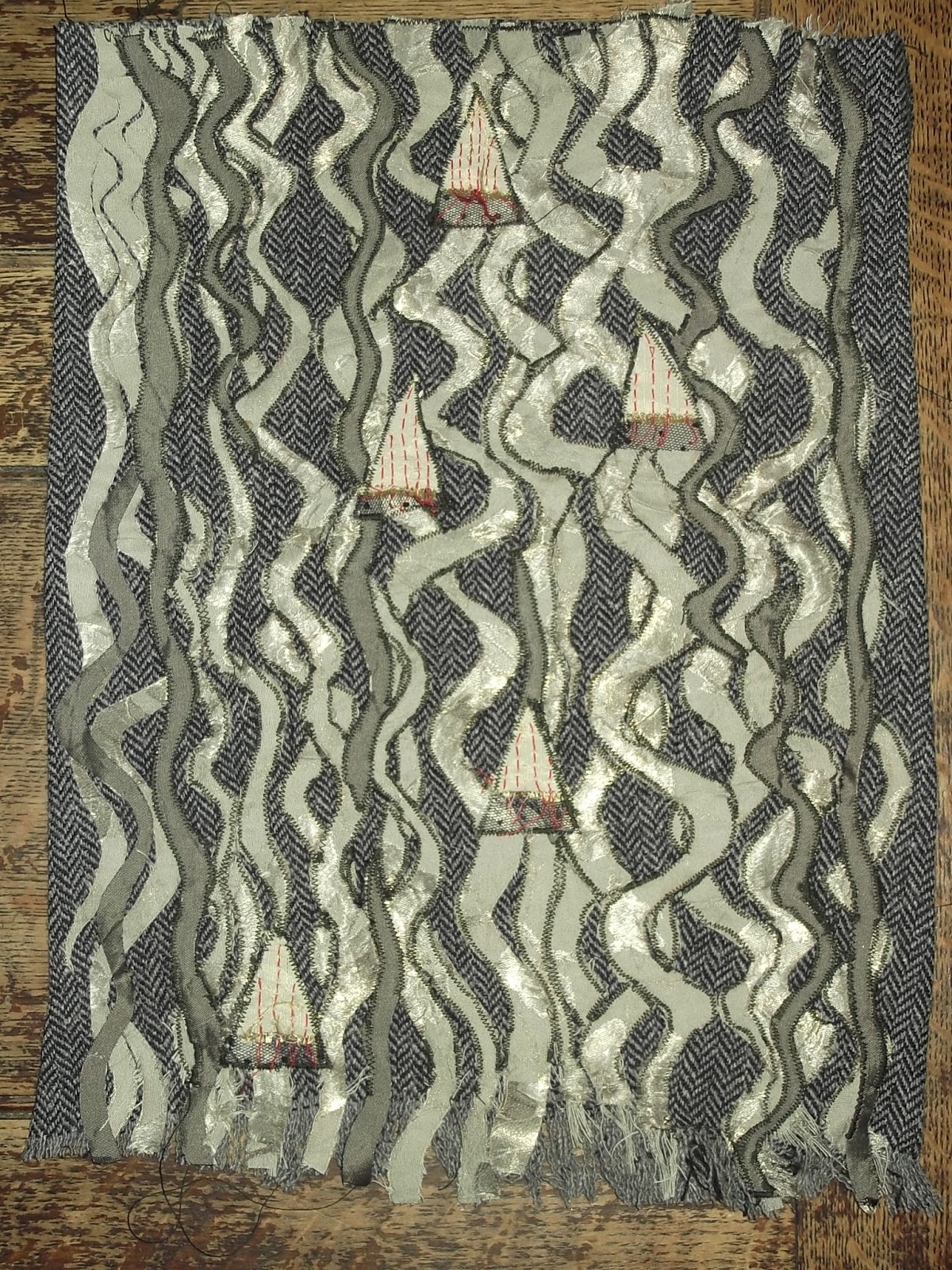
Before addressing the question, I want to say that there is an implication in the question that there is no good reason for the continued existence of textile crafts in the modern world. Which of course is a questionable premise to start from. And I am assuming that the question is referring to the Developed World, because craft shows no sign of being less useful than it always has been in other parts of the world.
It seems to me, reading for this course, and more specifically for this research point, that there is more than one meaning to the word crafts, and that this leads to all sorts of unhelpful apparent contradictions and sets up some distracting diversions when I am trying to think about the place of crafts in our world. And the most unhelpful of all, I think, is the separation of the word craft from the idea of craftsmanship.
The rest of this blog entry is my thoughts about some of the confusions around craft and craftsmanship, the apparent separation of it from the idea of 'craft', where this strange state of affairs might have originated, and about what the future of crafts could be if this were put right. I have generally written it from the starting point of my opinion, bringing in references to written and made works which illuminate (I hope) my train of thought.
 |
| Halloween Craft kit |
 |
| Summer crafts - foam rockets |
It seems to me, reading for this course, and more specifically for this research point, that there is more than one meaning to the word crafts, and that this leads to all sorts of unhelpful apparent contradictions and sets up some distracting diversions when I am trying to think about the place of crafts in our world. And the most unhelpful of all, I think, is the separation of the word craft from the idea of craftsmanship.
The rest of this blog entry is my thoughts about some of the confusions around craft and craftsmanship, the apparent separation of it from the idea of 'craft', where this strange state of affairs might have originated, and about what the future of crafts could be if this were put right. I have generally written it from the starting point of my opinion, bringing in references to written and made works which illuminate (I hope) my train of thought.
Crafts as an expression of tradition
Sometimes people write and speak about tradition in crafts as if 'tradition' referred to the techniques used to make particular things, and the typical patterns that have been used to make or decorate them in the past. And in this context, there can be some confusion about the fact that craftsmen often use their adeptness and the aesthetics of their craft to adapt and change traditional techniques and patterns. Or use them to express poetic ideas, address design problems which only arise in the modern world, or use materials which were not available to their predecessors. So people start to wonder if they are actually craftspeople, or are in fact artists, or designers instead. (1)
I think the apparent conflict betrays a misunderstanding of what craftsmanship is. A misunderstanding I think is in line with the presumptions in Tom Stoppard's epigram: 'Skill without imagination is craftsmanship and gives us many useful objects such as wickerwork picnic baskets. Imagination without skill gives us modern art.' In fact, in my opinion a person is a labourer, not a craftsman, if they do not sometimes take the opportunity to adapt their skill to new conditions, ideas, or materials, or at least see this as legitimately part of their work.
Looking historically at any tradition, any craft, one can see a long line of skilled craftsmen who were making, not exactly the same thing as their teachers, but something that incorporated both the techniques and ornament of those teachers and something of their own time. This is inevitable in any lively human activity.
Here is a Link to an outline of this happening in English ceramics, which also refers to the way historical changes inevitably bring changes in design and technique in crafts.
“You’ve got to know the rules to break them. That’s what I’m here for, to demolish the rules but to keep the tradition.”
—Alexander McQueen (11)
What do we call ourselves?
In an article in the Journal of Modern Craft online, Ramona Barry interviewed some jewellers about what they called themselves, and found that they were generally flexible about this, caring more often about not being pigeon-holed than about what they actually called themselves. One of these interviewees, Vicki Mason, is quoted as saying 'I'm a jeweller, perhaps not as some would know it in the traditional sense, but I make objects to wear essentially, and this is what jewellery aims for for the most part. It's about making objects to be worn.' (1)
Which begs the question as to who is asking craftspeople to label themselves, and why? I will think about this question later on in this post.
The Basic Necessity of Crafts
So, I believe that tradition in craft is more usefully thought of as the visible and tactile expression of the deep history of our culture since the first objects were made by our ancestors. The crafts are evolved adaptations of the techniques and skills derived from the response of the indigenous population to their practical needs, using available materials, and naturally reflect the aesthetic values derived from experiences of living with, or making, craft-made objects.
I think the apparent conflict betrays a misunderstanding of what craftsmanship is. A misunderstanding I think is in line with the presumptions in Tom Stoppard's epigram: 'Skill without imagination is craftsmanship and gives us many useful objects such as wickerwork picnic baskets. Imagination without skill gives us modern art.' In fact, in my opinion a person is a labourer, not a craftsman, if they do not sometimes take the opportunity to adapt their skill to new conditions, ideas, or materials, or at least see this as legitimately part of their work.
 |
| A basket made in 1985 by Mohawk artist Mary Adams It has distinctive curls and miniature sweetgrass baskets hanging from the lip. It seems to me that this shows both great skill, and witty imagination ie great craftsmanship. |
Looking historically at any tradition, any craft, one can see a long line of skilled craftsmen who were making, not exactly the same thing as their teachers, but something that incorporated both the techniques and ornament of those teachers and something of their own time. This is inevitable in any lively human activity.
Here is a Link to an outline of this happening in English ceramics, which also refers to the way historical changes inevitably bring changes in design and technique in crafts.
 |
| Lustreware William de Morgan 1880 |
 |
| Tin-glazed lustreware English 'after 1475' V&A |
 |
| Early 19th Century child's lustreware bowl & saucer |
“You’ve got to know the rules to break them. That’s what I’m here for, to demolish the rules but to keep the tradition.”
—Alexander McQueen (11)
What do we call ourselves?
In an article in the Journal of Modern Craft online, Ramona Barry interviewed some jewellers about what they called themselves, and found that they were generally flexible about this, caring more often about not being pigeon-holed than about what they actually called themselves. One of these interviewees, Vicki Mason, is quoted as saying 'I'm a jeweller, perhaps not as some would know it in the traditional sense, but I make objects to wear essentially, and this is what jewellery aims for for the most part. It's about making objects to be worn.' (1)
 |
| Vicky Mason Red sewn brooch 2008 Powder-coated brass, polyester thread, hand-dyed Photo by Terence Bogue |
The Basic Necessity of Crafts
So, I believe that tradition in craft is more usefully thought of as the visible and tactile expression of the deep history of our culture since the first objects were made by our ancestors. The crafts are evolved adaptations of the techniques and skills derived from the response of the indigenous population to their practical needs, using available materials, and naturally reflect the aesthetic values derived from experiences of living with, or making, craft-made objects.
 |
| A waterproof bag made by a Native American using the waterproof materials to hand. From the collection at the Royal Canadian Museum in Toronto |
People sometimes speak, and write, about crafts as a route to self-actualisation - the pinnacle of Maslow's Hierarchy of Needs, as if we only start making things when we have safety, enough to eat, a sense of belonging, love and meaning already in our lives. The truth is self-evident that the creative urge is much more fundamental than this. People have always made things in order to eat, in order to have somewhere safe and dry to live and clothes to keep them warm. And people make things in order to earn a living, attract a mate, and signal their membership of a particular group. And the people who are most drawn to the making of things are those people who do more of it, seek out teachers, and become skillful at it.
Crafts are Here To Stay
The satisfaction we derive from the experience of skillful making, or using of objects made well by other human beings, is not something that will go away with one or two generations of factory-made objects designed with profit in mind. Archaeologists have found clothes sewn from animal skins by Neandertal humans 500,000 years ago. The Cro Magnon people made weapons, but also made 'well constructed huts with central hearths for fires; necklaces & pendants, cave art, little statues made from ivory, antler, bone.' Human beings have been making things for so long that the ability to craft useful objects is likely to have contributed to our evolutionary success, and perhaps even to have been selected for by natural forces. So it's going to be a good long time before our tendency to create things is going away, even if we can buy them ready made in a factory. (2)
 |
| Solutrean needle, the world's first identifiable needles Image from Human Journey |
I see the last 60 years of the history of objects as representing an abberation in an otherwise unbroken history of respect for good craftsmanship. Respect, because good craftsmen made objects that were well designed for their use, resilient, and intrinsically attractive by virtue of having been well made.
There have been signs in the last 20 years or so that this respect may be returning. The introduction to a 2007 book about the resurgence of crafts in art and fashion, states, 'Along with the quiet proliferation of handmade work in the art world, there is a similar prevalence in fashion design, industrial design, and the book arts. The participants profiled in this book all share a dedication to materials and processes.' (4)
The executive director of the Crafts Council writes about a number of artists, marketing organisations, design organisations, and trade and investment fairs using the skills of craftsmen, in the November/ December edition of Crafts magazine. Referring to the British Business Embassy during the Olympics, she concluded 'To my mind it highlighted the current strength of the crafts sector and how seriously it is being taken by government and business alike.'(5)
 |
| Stack-ed Desk Rolf Sachs / David Linley, 2012 A desk made with no screws or nails, which was used to illustrate Rosy Greenlees' article (5) |
Craft as a Marketing Term:
The trouble with assuming that this means a resurgence of crafts in general is that it appears to be driven by the wish to make money. Which carries with it the risk that the use of craftsmen is merely fashion and will quickly pass. Although even if this is the case, all that is lost is that particular hyped up market, not the world of crafts and craftsmanship.
The use of market mores to talk about crafts seems to me to be a fundamental source of the confusion, and the loss of connection between crafts and the idea of craftsmanship. There is a huge market for people who want to learn crafts and another (up to 26 million people according to the Craft Council) for those who want to buy craft-made objects. (6)
But most of the market for people who wish to engage in crafts appears to be for kits which allow for no creativity. Chris Chrombie, chief executive of Hobbycraft, told an interviewer in 2009 that 'our research puts the value of the UK hobby market at £2 million.' The craftsmanship associated with this kind of market is of the kind that Tom Stoppard was referring to in the quote above. What I would call no craftsmanship at all. So the fact that it is, despite this, called 'craft', has detached the word from it's specific meaning of special skill.
Craft as 'the other' for Fine Art
Howard Risatti, in his thorough and readable approach to the theory of craft, aimed 'to show how the craft object is a fundamental expression of human values and human achievement that transcends temporal and spatial boundaries as well as social, political and religious beliefs.'
In other words that craft does not have to define itself in relation to fine art, because it has its own nature and virtues which are independent from those of fine art (but overlapping in places). That it has been difficult for the crafts to find their way to this realisation because of fine art's need to define itself as being unlike crafts, and because of the cultural hierarchy of creative endeavours that this has set up.(3)
Slow Textiles:
The use of market mores to talk about crafts seems to me to be a fundamental source of the confusion, and the loss of connection between crafts and the idea of craftsmanship. There is a huge market for people who want to learn crafts and another (up to 26 million people according to the Craft Council) for those who want to buy craft-made objects. (6)
But most of the market for people who wish to engage in crafts appears to be for kits which allow for no creativity. Chris Chrombie, chief executive of Hobbycraft, told an interviewer in 2009 that 'our research puts the value of the UK hobby market at £2 million.' The craftsmanship associated with this kind of market is of the kind that Tom Stoppard was referring to in the quote above. What I would call no craftsmanship at all. So the fact that it is, despite this, called 'craft', has detached the word from it's specific meaning of special skill.
Craft as 'the other' for Fine Art
Howard Risatti, in his thorough and readable approach to the theory of craft, aimed 'to show how the craft object is a fundamental expression of human values and human achievement that transcends temporal and spatial boundaries as well as social, political and religious beliefs.'
In other words that craft does not have to define itself in relation to fine art, because it has its own nature and virtues which are independent from those of fine art (but overlapping in places). That it has been difficult for the crafts to find their way to this realisation because of fine art's need to define itself as being unlike crafts, and because of the cultural hierarchy of creative endeavours that this has set up.(3)
One thing that seems to identify craftsmen/artists in our capitalist world is the slowness of the work. When time is money and profit is everything, spending months on making one object can be difficult for non-creative people to understand. Shu Hung and Joseph Magliaro editorialise about the craftsmen they interviewed for their book, 'They admit to spending months on a single piece with no end in sight and, in fact, luxuriate in their long production time. They abandon efficiency to pursue completion in their work, with the results sometimes landing far away from the original design.'(4)
This is not a new idea, of course, as it relates to many movements since the industrial revolution trying to engage us in the political process of slowing down, re-evaluating the importance of the human element, both in the making and the appreciation of an object. One of those movements was led by William Morris, and he wrote about the ideals of craftsmanship, but even he was only partially able to reconcile these ideals with the need to make a profit. (7)
This is not a new idea, of course, as it relates to many movements since the industrial revolution trying to engage us in the political process of slowing down, re-evaluating the importance of the human element, both in the making and the appreciation of an object. One of those movements was led by William Morris, and he wrote about the ideals of craftsmanship, but even he was only partially able to reconcile these ideals with the need to make a profit. (7)
The following is a quote about slowness from thetextileblog.blogspot.co.uk, which I have been following for the last few months because many of the opinions expressed in it chime with mine.
'Slow, means the physical and mental process of slowing down, taking a breath, allowing a human timescale rather than a machine one, to take control of events within our lives. In the context of design, this means re-examining the process of production, repositioning technology, and allowing room for a human dimension. It used to be considered, and still is within large sections of society, that the large scale use of technology and industry in a way that divorced itself from the human dimension, was an affirmation of our progress and destiny as a species, that it could produce items faster than hand or small-machine production, seemed almost a negligent by product, the larger the scale and the faster the production, the better. The near boast that things could only ever get better, looking at much of the pollution, degradation of the individual and social quality of life in general, as well as the lack of concern for what actually happens to the millions of items produced every day, is a very hollow, even shallow boast and perhaps shows the human species as it really is, hands forever reaching for that distant shiny future, whilst having two feet firmly sitting in the mud of reality.
Slow can be added to practically any title, giving new definition and dynamism to a subject or discipline, particularly in the creative field. To be able to stop, contemplate, be inspired, is probably the most important aspect that a human can add to the creative process, indeed, the most important. So in some respects, slow could actually be defined as human, Slow Design being the human intervention within the design world. The design and craft world needs to take an holistic approach to both designing and making. The complexities of human life, both inner and outer as well as our ability to observe and reflect, needs to be entwined with the design process, not just at the end, as a form of human veneer, but at every stage of each and every discipline from start to finish.' (8)
I first heard of the slow textiles movement when following a link from the craft council website to a textile artist who works in Brixton. She was a member of the Slow Textiles Group, and I am thinking of trying to talk to her, or to them, about the way they think about what they do. (9)
Hopes and Fears for Craft
I initially ended this blog with a quote from William Morris from a series of lectures entitled 'Hopes and Fears for Art.' (10) But the world has moved on in over 100 years and while his fears were similar, for his own area of 'decorative art', his hopes were confined by the social and cultural milieu he lived in, where people lived and worked with a fixed hierarchy, in a world where you had to pick your career from a limited number, sometimes before your were born, and then stick with it until you died. The difference in work patterns now, with portfolio careers, and the ease of changing career, and the advent of the internet as a place for exchanging opinion and selling relatively small market goods, could result in an even greater resurgence of crafts. Or it could leave us with only very few with the necessary years of practice to develop craftsmanship.
Bibliography
(1) www.journalofmoderncraft.com Post by Ramona Barry August 20,2011
(3) 'A theory of Craft: Function and Aesthetic Expression' Howard Risatti 2007 University of North Carolina Press
(4) 'By Hand: The use of craft in contemporary art' Shu Hung & Joseph Magliaro eds. 2007 Princeton Architectural Press.
(5) 'A decade of design' Rosy Greenlees Inside Edge, Crafts Nov/Dec 2012
(7) William Morris's ideals
(8) www.thetextileblog.com
(9) Slow Textiles School
(10) Hopes and Fears for Art - a series of lectures by William Morris 1881 Link to the collective commons readable version
(11) Alexander McQueen quoted on the Metropolitan Museum NY website Link to Met museum
(11) Alexander McQueen quoted on the Metropolitan Museum NY website Link to Met museum