Wednesday, 24 July 2013

Reliquaries

After my opus angicanum reading online, I decided to go to look at some actual Medieval objects and visited the British Museum.

Reliquary casket for Thomas Becket
Copper and enamel 1210 British Museum
Image from Wikimedia
This reliquary caught my eye. A reliquary was a box which held a relic of a saint - either a piece of their body, or something that had been close to them in life. A reliquary was designed to be carried with someone when they travelled, and was often thought to be able to perform miracles. There was a belief that the body parts of a saint were so pure that they would not rot.

This one claimed to contain a piece of St Thomas a Becket. He was born in Cheapside in London in the twelfth century (to Norman parents) and became a priest, eventually to become Archbishop of Canterbury. He was such a good friend of King Henry II that he was chosen to bring up his son Prince Henry.

He had to flee to France after disagreeing with the king about how much power the crown should have over the church. He returned 2 years  later after a compromise agreement, but then refused to sign the agreement, and he was killed, while at prayer in Canterbury Cathedral, by the king's men. King Henry II was supposed to have said 'Will no one will rid me of this turbulent priest?', and this was taken as an order. There is some doubt about this according to the sources I read.

http://laudemgloriae.blogspot.co.uk/2012/12/similarities-between-st-thomas-becket.html

His body was buried under the cathedral to protect it, and then dug up again to be moved to its final burial site in early 1200. At this time 45 reliquaries were made in France, with the story of his life and death painted on it, one of which is at the British Museum.


These two are reliquaries also kept in the British Museum.


This one contained a wooden box inside, with a lid, to put the relic into it.

Heads were often thought to contain the head of the saint, hands the hand etc.


On the left is the 'Arm Reliquary of the Apostles' which is known to contain an arm bone (The apostles are part of the decoration). Silver gilt over oak, 12th century.


The ornate carving below was also a reliquary from the BM, perhaps the base of a cross. The ivory symbolises purity.


http://www.learn.columbia.edu/treasuresofheaven/relics/Reliquary.php 

This one is an African reliquary that I found on the internet, on display at the NY Metropolitan Museum of Art exhibition 'Eternal Ancestors'. It looks lovely and delicate and fragile, with a mild character all its own.

Like all of these containers, the idea that they contain body parts of actual people makes them strangely beautiful-grotesque.

What appeals to me about this and the whole Medieval idea of reliquaries, is that it is an object that you can hold and carry around with you, that contains something lost for ever, but that somehow is still full of power. This is a great metaphor and worked in my head a lot after I visited the BM.


Sunday, 21 July 2013

Opus Anglicanum

Opus Anglicanum

This is 'English Work', high status embroidery for church and kings in the Medieval period. It had a very good reputation and there were more than 100 examples of it at the Vatican in the 1300s.
Fundamentals of opus anglicanum with references

There aren't many examples left because it used a great deal of gold and silver thread, which was later removed and reused, and because of Henry VIII dissolving the catholic monasteries during his reign.

Butler-Bowden cope 1330-50, V&A no T.36-1955
Silk velvet (woven in Italy), silver and silver-gilt thread and coloured silks
Taken from wikicommons
The velvet or linen was embroidered completely, or almost completely. Techniques used included undercouching and split stitch.
For an interesting discussion about what opus anglicanum tells us about Medieval culture

Detail of English Altar front 1315-35
http://medieval.webcon.net.au/technique_opus_anglicanum.html
The detail of the techniques copied below is also from this site.


Underside Couching
To Work Underside Couching - In the embroidery technique of underside couching, thread (usually gold) is laid on the surface of the ground fabric, couching threads are then passed over it. As each couching stitch is worked over the gold thread, the needle is carefully re-inserted into the hole in the backing fabric that the needle created on the way out. The couching thread is pulled tight and a tiny loop of the gold thread from the surface drops through the hole in the backing fabric to the underside (thus giving the technique its name).
This creates a hinge in the gold thread, allowing the fabric to bend and giving it a great flexibility. Fabric worked with gold thread in underside couching has much more drape than fabric with surface couched gold, thus making it a much better technique for working objects which will be worn, such as ecclesiastical vestments.

Laid and Couched Work

Laid and Couched Work, is a form of embroidery where a thread (usually wool ) is laid on a ground fabric (usually wool or linen ). This stitch is created by laying a set of ground threads, that work from one side of the pattern to the other (Fig a). Over these threads, in the opposite direction, are laid another set of threads at regular intervals (Fig b). These cross threads are then held down by a series of couching stitches (Fig c). The whole process results in an area completely covered in thread. This technique allows for large areas of pattern to be covered very quickly.


Split stitch is backstitch where the needle goes through the last stitch rather than the last hole.

Embroidered bookbinding for the Felbrigge Psalter in couched gold thread and split stitch, likely worked by Anne de Felbrigge, a nun in the convent of Minoresses at Bruisyard, Suffolk, during the latter half of the fourteenth century.
Photo and title from Wikipedia entry on opus angicanum

So, after looking through these websites and others, I'm thinking that I should have a go at doing this undercouching. I particularly like the way the gold background are textured and patterned by this without taking over from the detailed images in front. I am interested to see how difficult it might be to produce a reasonable looking face with split-stitch, and also noticing that most of these images have an appealing convention that images are divided and framed with architectural shapes.

Syon Cope from vam.ac.uk


Here is some of the sketchbook work I did as a result of this investigating of medieval images.


Saturday, 20 July 2013

History Now! and the Middle Ages

All this wandering about in African images was tempered this week by a series of visits I made during our family holiday. First we went to Pembrokeshire and between healthy outdoor activities we visited St David's Cathedral on the West coast.


This is the nave, which gives you an idea of the ancientness of it.
It is the oldest part still standing and is 12th century ie the middle of the middle ages.
The oak ceiling was added in 16th century, and looks pretty fresh. 

A photo of the floor tiles that particularly caught my eye can be found by clicking on this link. 
(My version of the same photo is below but much poorer quality).


The simple natural colours and stylishly controlled leaf patterns appeal. As does the way they have been all put together higgledy-piggeldy here. Perhaps they are familiar because of the use of similar images and styles by Laura Ashley in my 1970s childhood. Or just because such things are all over England and Wales in one degree of decay or other. It was refreshing to be looking at images so familiar and resonant for me personally. I began to wonder whether references to an ancient version of my own culture would be considered cheating for this part of the course. 

http://www.loyaltybindsme.org
Medieval floor tiles from Winchester Cathedral, showing the lovely colours
if not the sophisticated designs of the St David's tiles.

This is the grotesque carved into a misericord on the altar.
This was a narrow shelf placed to allow a priest some rest during celebrations of mass.
A bit like what they provide in some fast food restaurants.

There were also some faces around the roof supports of the Bishop's Palace next door to the cathedral.
The faces  were grotesque on the outsides of the walls, and calm and pleasant on the inside.


Some images from the tourist information boards at the Bishop's Palace at St David's
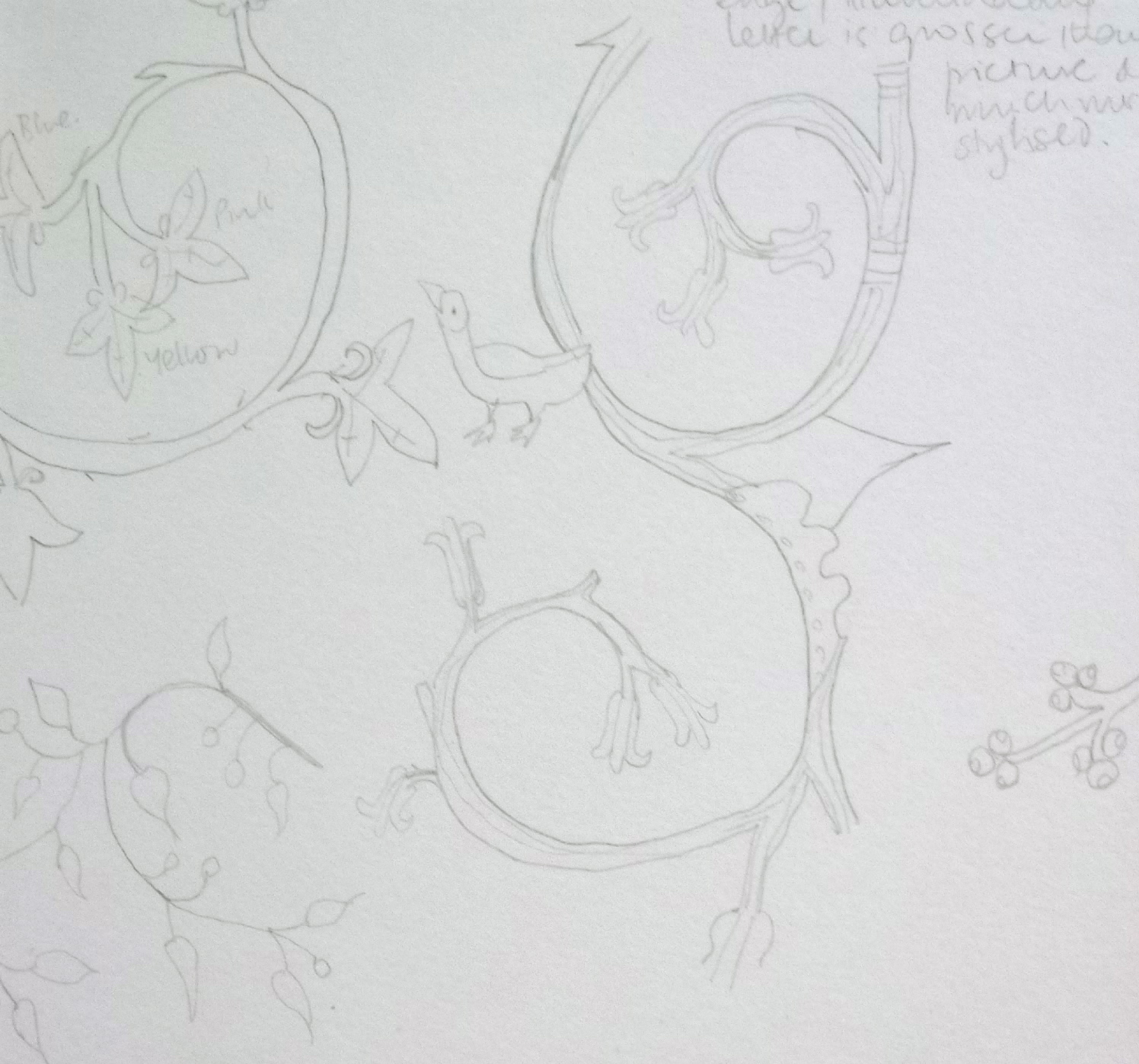
I loved the simple style, the representation of ordinary everyday things, and the vine leaf decorative swirls. The illuminated letter in the middle is from the Treaty of Medicine by Aldebrande of Florence, dated 1365 at the British Library


A week later we visited the marvellous History Now! festival for historical reenactors organised by English Heritage. Most of the participants were dressed in historically accurate costume, and much of that was from the middle ages. I did some sketches and found out a lot about fashion trends from the mid- middle ages. Interestingly, early middle ages were decorated more like Viking clothes, but by 12th century wealthy women were wearing girdles, and had long trumpet sleeves, often with a contrasting colour inside.

Images from History Live! 2013
There are lots of people dressed in clothes that would have been expected in the Middle Ages.  The ladies are wearing linen veils, simple overdresses with hand-made chord girdles over white dresses. Men (and boys) wore woollen tunics. The man in purple has unusually rich clothes, purple signifying royalty, and appears to be dressed as a crusader (13th century). The soldiers at the top were demonstrating how to use a sword, and are wearing chain mail over quilted garments to protect them from harm. They seemed to be a lot later in history than the soldiers at the bottom left, who  are dressed as Saxons fighting for King Harold at the Battle of Hastings in 1066. The doorway is just an attractive door I saw in Bristol.

This glassware was from a stall at History Live! selling replicas of glass from various periods of history.
I was surprised and delighted with the variety. I thought the spiral beaker was particularly
fine and interesting, and would be comfortable to drink from. 


Seeing these things, and feeling the calm but busy atmosphere of the Cathedral and Bishop's Palace led me to do some sketchbook studies of Middle ages designs, and an investigation of embroidery from that same period of around the 12th century (see Opus Anglicorum entry).

Thursday, 18 July 2013

Sketchbook work - cowrie


Cowrie - shape 

Copied from an online photo of a deer cowrie - the spots on the back are like the spots on the back of a deer.

Drawing this made me look harder at where the ridges are down the sides of the entrance. They are not where I thought but further away from the vulnerable gap, and there's a shiny pinky-white region that looks rather slippery in between. (presumably to allow the 'foot' of the cowrie creature freedom of movement.)

The shape is not nearly as almond-like as I thought it was - much more complex.

The ridges and the lips at top and bottom of the entrance are hard and forbidding.


Cowrie - colour

I tried this colour study with normal watercolours rather than designer gouache as usual (as I was on holiday) and I didn't get the colours as accurate as I would have liked.

The inside colour is completely wrong - it's much more nuanced and with a purple tinge to it.

The other colours were reasonably accurate. I needed a lot of water to get the palest ones so the paper got distorted.

What I learned from this is that I need to use the right paints to get a good result.


 Cowrie calabash - exploring shapes and patterns


The combination of string squares with cowries at each corner appealed to me. I explored this idea in various ways - both using the distortion of the gourd shape, and using regular squares. The regular squares made me think about the Kente strip weaving, and how I could make that the background of the piece. I also thought about different ways to represent the shiny hard cowries, and how to keep the contrast of the fecund roundedness and the dangling tinkling shells.

I have been focussing on the feminine aspect of these shells, but the money/ possession idea might still be part of it if I use cowries for my piece.


I also drew a representation of the cowrie necklace which had that lovely combination of regularity and natural variation, thinking that I could perhaps embroider something with a similar feeling.

I think it looks rather regal, but on reflection it needs something more before I make it. Some work on colour, and texture too. And background. 


An old obsession
At this point it occurred to me that my attraction to cowrie shells is nothing new. I have some images in my photo store from about a year ago of a geode from the Natural History Museum which is a similar shape, and gave me similar associations. 


This is the geode - a naturally occurring rock formation with crystals inside. I find it mysterious and sexy.

I did some sketches last year about how to make the inside give that feeling more clearly.

Some of the imagery was about time passing, but this is not so relevant to cowries, I think. For them it is more
about femininity, vulnerability protected by a hard shell.


This week I found a cork tree and took a photo of its bark. I think this is more like the complexity and softness that is hiding inside the cowrie shell.

This is the sketch I made of it. I don't know if I can use this in a final piece, but it does give me the feeling I want.

I have had some things I have wanted to try out as samples, but I haven't tried any of them yet.

After this sketchbook work I have a range of ideas that I could work on more, but I also have another interest, in the Middle Ages.


I am thinking I should pursue that a bit more, and then decide which ideas to take into a final piece for this project.


Sunday, 14 July 2013

Textiles from Ghana

Some time ago I realised that many of the fabrics that appealed to me in London street markets were made in Ghana. I have never got round to exploring this more, and this course seems like a good opportunity.

At http://www.craftrevival.org/voiceDetails.asp?Code=294 there is a piece written by a Professor at Ghana University which gives a good summary of the different kinds of cloth and something about their history. What is written here is mostly based on that.

Kente

This is woven cloth made by master weavers for the Kings of Ashanti, is highly prized, and there are two overall styles, Ewe kente and Ashanti kente. The Ewe style is more subdued in colour and mood, but there has traditionally been more room for creativity as the Ashanti kente range was limited by being used in court. In the 18th century Ashanti weavers used silk from European imports to add shine to their patterns.

The technique is strip weaving. Strips are made about 4 inches wide and several foot long on a small loom and sewn together. They are worn like a wrap or toga and differently for men and women.

The colours are bright and attractive, for ceremonial occasions. Colours and patterns have symbolic significance. Each pattern has a name, which commemorates important events in the lives of kings.  'One assumes dignity when one wears kente.'


http://www.lizard-dance.com/images/full_size/F-African-Inspirations-2f-g.jpg
You can see the weight of it, the strips, and the complexity of the pattern, from this photo.

Meanings of the colors in Kente cloth: (From Wikipaedia entry on Kente cloth)

  • black—maturation, intensified spiritual energy
  • blue—peacefulness, harmony and love
  • green—vegetation, planting, harvesting, growth, spiritual renewal
  • gold—royalty, wealth, high status, glory, spiritual purity
  • grey—healing and cleansing rituals; associated with ash
  • maroon—the color of mother earth; associated with healing
  • pink—assoc. with the female essence of life; a mild, gentle aspect of red
  • purple—assoc. with feminine aspects of life; usually worn by women
  • red—political and spiritual moods; bloodshed; sacrificial rites and death.
  • silver—serenity, purity, joy; assoc. with the moon
  • white—purification, sanctification rites and festive occasions
  • yellow—preciousness, royalty, wealth, fertility

Adinkra

Hand-printed traditional textiles that were used for funerals of high status people from the 18th century. Traditionally in sombre colours with black paint for the symbols. Made with carved gourd stamps on imported cotton. The stamp patterns have meanings.

Adinkra symbols from www.tumblr.com/thesouldetox
Adinkra hand-carved gourd stamps
from afaithfulattempt.blogspot.com
which has some other interesting info about Adinkra


Adinkra cloth wrapper belonging to King Prempeh 1
Ghana c1896 imported cotton, black paint
National Museum of African Art

Fanti cloth

Appliqued and embroidered textile made for high status Fanti men.
The appliqued symbols have meanings relating to the strengths and exploits of the man wearing it, and are used for ceremonial purposes. The colours are bright and clear.

Machine-made fancy print textiles

This is the cloth that is worn by most. It is different from the cloths described above in that its production is less localised and it is made over much of West Africa so is not just Ghanaian (although there are local differences). 

Wax-printed cloth is the more prized version, roller printed cotton being cheaper and more freely available. The difference is that wax-printing leaves the pattern on both sides of the cloth, and roller-printing is more able to give sharp detail and can use photographic images.

African wax print fabric, from http://thecraftbegins.com/wordpress/2010/02/05/african-wax-print-fabric/african-wax-print/ 

Colonial Dutch tried to undercut the indonesian market for Javanese batik by producing machine-made versions of similar style. It didn't work in Indonesia, but Ghanaians loved it. They adopted it for themselves and added traditional motifs and associated proverbs to the patterns.

There is a very readable essay in www.beyondvictoriana.com with more detail about this...

'Lest it seem that the introduction of Dutch wax prints into the West African market happened out of the blue, West Africa had always been a textile market, since fabrics have been important aspects of African social life for a very long time. As early as the 16th century, the English, Dutch and French were selling batiks and other types of textiles manufactured in Asia, such as the “guinea cloth” and Indian produced cottons from Pondicherry, now Puducherry, to West African markets. Thus consumers were quite accustomed to globally-produced fabrics. The introduction of Dutch batik-inspired wax prints lead to the peak of foreign-manufactured fabrics in West African markets in the 19th century.'


Wax printed cloth "Weni behu naaso w'ano enntumin nnka" (Your eyes can see, but your mouth cannot say). Printed in Ghana, 2006. - See more at: http://media.photobucket.com/user/fakehorn/media/touring_fabricnation_385.jpg.html?filters[term]=textiles%20say&filters[primary]=images&filters[secondary]=videos&sort=1&o=2#sthash.9IGygaaA.dpuf

Ghana-produced textile companies sell to the English Market. I particularly like the idiosyncratic look of this one.
Vlisco fabric order no. VL035914.04

Batik, tie & dye, wax resist cloth

There was a surge in the local production of these in Ghana in the 1960s and 70s through Intermediate Technology Transfer initiatives. There was a dip in popularity for these fabrics, but the market has picked up again now. They generally use locally produced cotton and use traditional motifs and sometimes produce commemorative fabrics to mark important events. 

These cotton fabrics, unlike the Kente and Adinkra cloths, can be cut and sewn into clothes rather than being used only as drapes or togas. The dress patterns often incorporate large elaborate sleeves and shoulders. 


I'm thinking it might be fun to try out some wax resist dyeing of my own. Perhaps even using images from cowrie exporations. I haven't done a lot of repeat patterns and this looks like an inspiring way to explore this a bit more. 

I'm also thinking about how I have made quilts in the past in reference to an important personal event, like my wedding, but somehow this cultural idea of recording an important event for society in that way seems a little different. Perhaps a funeral cloth marking the introduction of welfare reform? The obvious one for now is the birth of an heir to the throne, but as a bit of a republican that doesn't inspire me. Hm...food for thought.


Saturday, 13 July 2013

Cowrie Shells

Cowrie Shells

My imagination was caught by the description of cowrie shells in the introduction to the first task of the course.

What appeals? They are natural creatures honed by the sea into a tiny and intriguing shape. The combination of simple shape and delicate complextiy appeals visually. And the cool feel of the smooth outside, contrasted with the sharp regular nippy teeth protecting the softness inside the shell.

They were taken to Africa by Arab traders in the thirteenth century, and again by Dutch and English traders through the Guinea Coast ports of West Africa.

'They were used as money, and once the commonest currency in Africa. The ancient egyptians put them in their millions into Pharoahs tombs,' and I have read that they 'thought they were 'magical agents'. In parts of Africa they have been used for bridewealth, payments for fines, divination ("the money of Ifa"), funerals, initiation into secret societies', according to http://www.farafina-tigne.com/beads/shell.html.

The symbolic meanings are so very intuitive - tokens of value, and femininity. The combination of these two hooks my interest. Symbolising the side of being female which is possessed like money. But more subtle. Perhaps the magic is part of the feminine. This is illuminating some dark corners of my head about my femaleness that I didn't know were there. There is something about visually expressing sexuality in such an indirect way that allows complexity to bring its harmony.


So, here is a selection of cowrie images that caught my eye on Google search
http://kitchenwitchuk.blogspot.co.uk/2012/02/magic-of-sea-shells.html

tumblr/coffee-cigarettes-couture
This one really has a feeling of natural restriction
that seems important. 
Addhttp://www.seashellmarket.com/catalog/
product_info.ph?cPath=23&products_id=89caption

Single shell on its own gives a very different feel.
Love the pattern on the back - want to give it a go.
The eye is drawn to the darkness inside.
Golden cowrie
www.animalsgallery.com
This one has fleshy colours, and the combination of
shine and regular 'teeth' makes it look as if it could eat you.
Deer Cowrie
Another fantastic pattern. And lovely colours. And interesting shape. 

http://www.scubadiving.com/photos/
how/nick-hobgood-avila-beach-calif

http://commons.wikimedia.org/wiki/
File:Cypraea_tigris_(Tiger_cowrie).jpg
These are photos of live cowries in the water, showing that they have a surprising mantle of sensitive tentacles. It's easy to imagine them slimy and soft and timid when you touch them. What a contrast to the shiny hardness of the shell.
Add http://konacoastdiving.blogspot.co.uk/2010/07/tiger-cowrie-encounter.html
And this one has great colours and textures around it too.
And just look at what the water and light do to the patterns on the cowrie.
There's this great combination of beauty and disgust in some of these images.

http://invertebrates.si.edu/Features/stories/cowrie.html

http://www.africancraftsmarket.com/
othermusicalshaker_details.htm
Regularity and the combination of
female vulva symbols and pregnant belly

Theres another one of these shakers in a photo at http://www.shutterstock.com/pic-1237249/stock-photo-african-shakers.html that has layers and layers of shells looking like a dancing skirt.


It seems to me that there's a lot here to explore for this project. But there are of couple of other cultural things I want to have a look at first.

 http://www.farafina-tigne.com/beads/shell.html
Just loved the way the pattern is regular and attractive,
and the individual elements are all slightly different
in colour and shape.


Thursday, 11 July 2013

OCA Textiles: Exploring Ideas


Dear Christina
As your tutor on Textiles 1: Exploring Ideas, I am writing to introduce myself. My name is Lisa Bloomer and I will be your tutor for this course. As well as working part-time as a tutor with OCA, I am an independent textile designer and employed as a senior lecturer on several BA Textile degree courses in the UK. I am confident that you will find your experience with OCA challenging and enjoyable and look forward to sharing your progression through this course.
Please send me a couple of paragraphs describing your textile experience to date, and your intentions, ambitions and aspirations, so that I can provide you with tailored support.
According to the initial information I have received, it looks like you will be working towards a degree. Please can you confirm that this is correct?
As you have chosen to study for a degree, you will need to engage in both academic and practical study. The development of a Learning Log (or Blog, if you prefer), in line with your practice and not separate from it, is essential to this process. For instance, if you are working on a project involving collage, your Learning Log should contain research into contemporary practitioners who engage with this as well as the more obvious precursors. The Learning Log should contain evidence that you are critically engaged with the subject and that your study extends beyond the information in the course book. It is important that you understand the role of the Learning Log so make sure you look at the information in the guide to Keeping Sketchbooks and Learning Logs and the video on OCA Essentials.
If you haven’t seen it yet, I recommend the induction course on the student website to help you get off to a good start. It's designed to introduce you to some important concepts and practical techniques that will help you as you prepare to study in higher education.
I suggest that we use email as our primary method of contact, but I am happy to receive occasional telephone and Skype calls as well (by appointment, at a mutually-convenient time), if that works better for you. I am not employed by OCA on a full-time contract, so my other commitments may mean I cannot return your email immediately, but I will reply as quickly as possible.
It will help your studies if you create a time-planner, which allows a realistic amount of time per assignment. I suggest we allow 8-12 weeks between assignments and set assignment hand-in deadlines to reflect how much time you are able to commit to your study. I’ll set a 10-week deadline for Assignment 1. If you think you won’t be able to keep to this timetable, keep me informed and we can set a more appropriate deadline.
I will provide feedback on the first assignment I receive from you, but Assignment 1 is not a formally-assessed component of the course. It is designed so that I can give you useful feedback at an early stage and start you off on the right track. 
The student forums are a good place to discuss ideas and gain inspiration from your fellow students and you will find useful online learning materials on Learning Logs/Blogs and Assessment on the student website and WeareOCA. If you are still unclear about anything and have any questions, please don’t hesitate to contact me.
I’ll set the deadline for Assignment 1 once I have received your profile. I look forward to hearing from you.
Best wishes
Lisa Bloomer